
Trout Stream Property for Sale in 2026: What Most Buyers Learn Too Late About Private Water
Key Takeaways
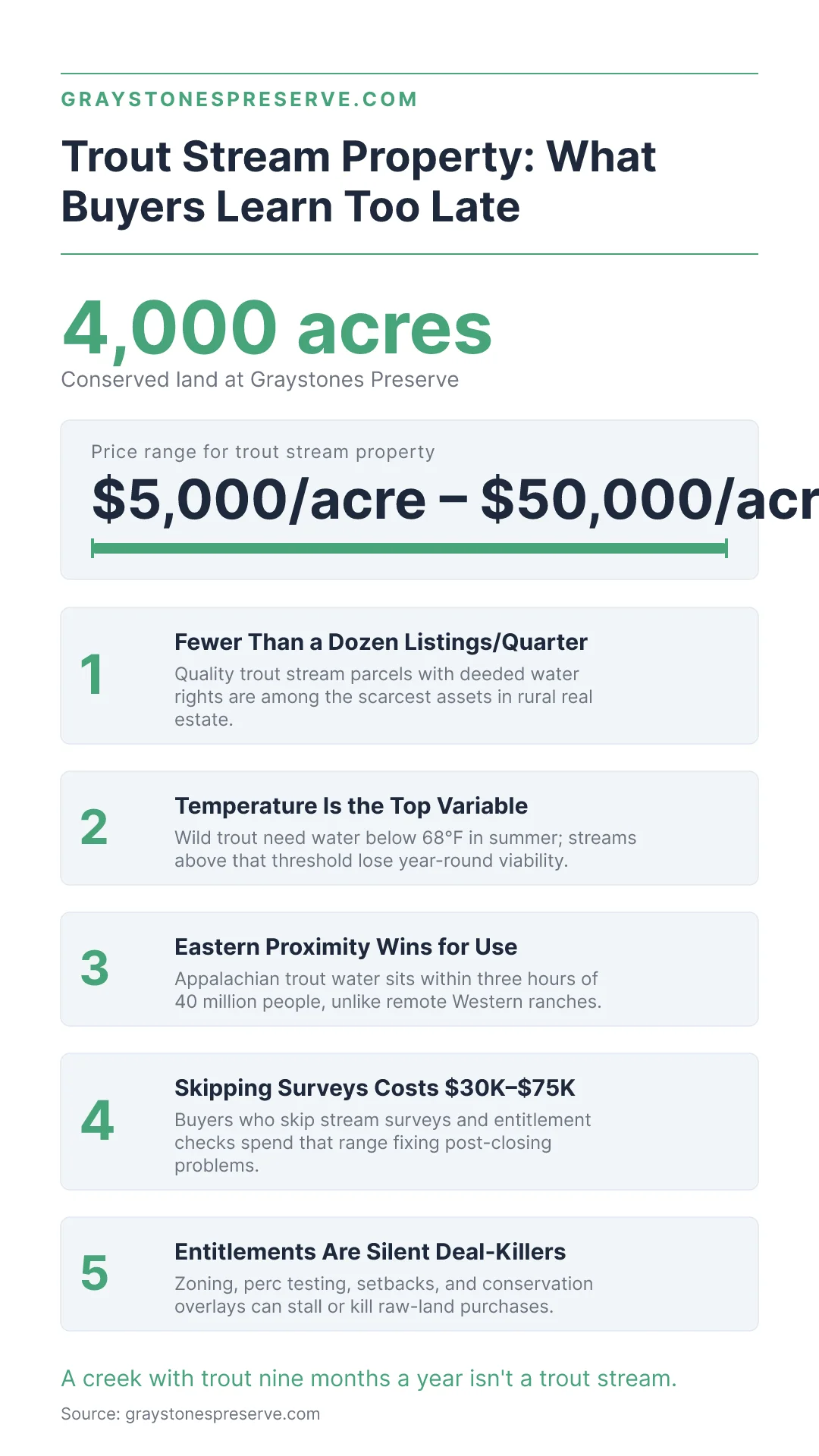
- Trout stream property with deeded private water rights is among the scarcest asset classes in rural real estate, with fewer than a dozen quality listings appearing nationally in any given quarter.
- The difference between owning a private trout stream and owning land near a public one is the difference between a legacy estate and a liability.
- Eastern Appalachian trout stream properties put private water within a three-hour drive of 40 million people — an advantage Western parcels can't match.
- Buyers who skip professional stream surveys and entitlement verification routinely spend $30,000 to $75,000 post-closing on problems that should have killed the deal.
Why Trout Stream Properties Command Premium Value
Trout stream property with resolved entitlements, deeded water access, and conservation protections eliminates the costly risks that sink most raw-land purchases. At Graystones Preserve, homesites sit within 4,000 conserved acres featuring private fishing waters, pre-permitted building sites, and settled water rights — the certainty most buyers spend tens of thousands chasing on their own.
What to Look for in a Trout Stream Property
A trout stream property is only as valuable as the stream itself, and most listing descriptions won't tell you what you need to know. Cold water, clean gravel substrate, and diverse insect hatches are the baseline.
Temperature is the single most important variable. Wild trout need water below 68°F through summer. A stream that warms above that threshold in July isn't a trout stream — it's a creek with trout in it for nine months. That distinction matters enormously for long-term property value. Before putting money down, commission an independent electrofishing survey from a qualified fisheries biologist.
| Stream Health Indicator | What It Tells You | Red Flag |
|---|---|---|
| Water temperature (summer) | Trout viability year-round | Above 68°F in July/August |
| Wild trout density per mile | Ecosystem carrying capacity | Below 200 fish per mile |
| Age-class distribution | Natural reproduction success | Only one size class present |
| Macroinvertebrate diversity | Water quality and food supply | Dominated by pollution-tolerant species |
| Streambed substrate | Spawning habitat quality | Embedded or silted gravel |
| Riparian canopy cover | Temperature regulation | Less than 50% shade coverage |
Don't take a seller's word for stream quality. Most sellers don't know. They know they've caught fish there — that's not the same thing.
Beyond the stream, surrounding land determines whether the property functions as an estate or a headache. Mature timber buffers filter runoff, stabilize banks, and regulate temperature. Verify that access roads are deeded, not permissive, and maintained through winter. Graystones Preserve's natural features illustrate what a fully resolved property looks like: mature hardwood forests, cold-water streams, and pre-permitted building sites with year-round access.
Top Regions for Trout Stream Land Opportunities
Trout stream land clusters in two broad corridors with dramatically different cost structures and accessibility profiles.
Western estates in Montana, Colorado, Idaho, and Wyoming offer scale Eastern properties can't match. Parcels of 100 to 1,000 acres on celebrated rivers routinely list between $5,000 and $15,000 per acre, with premier frontage pushing above $25,000. But they carry a hidden cost: remoteness. A ranch on the Ruby River is a full travel day from New York.
Eastern Appalachian properties flip that equation. The Poconos, the Catskills, Virginia's Blue Ridge, and western North Carolina all hold quality trout water within three hours of major metros.
| Factor | Mountain West | Appalachian East |
|---|---|---|
| Typical parcel size | 100–1,000+ acres | 3–50 acres |
| Price per acre (quality stream) | $5,000–$25,000+ | $8,000–$40,000+ |
| Drive time from major metro | 5–12 hours (or flight) | 1.5–3.5 hours |
| Trout species | Rainbow, brown, cutthroat | Brown, brook, rainbow |
| Water rights framework | Prior appropriation | Riparian |
| Weekend-use feasibility | Low | High |
The Eastern advantage is worth its weight in gold for any buyer who plans to fish more than a handful of weekends per year. Proximity turns a property from an asset you admire into one you actually use. Pennsylvania's Pocono region sits roughly two hours from both New York City and Philadelphia.
The Buying Process for Private Trout Stream Estates
Buying trout stream property isn't like buying a house in the suburbs.
Water rights title research comes first. Confirm what you're actually buying before you fall in love with a stretch of freestone creek. The Pennsylvania Fish and Boat Commission maintains public records on stream classifications that help verify status.
Entitlements are the silent deal-killers. Zoning variances, septic perc testing, environmental setbacks, conservation overlays: on raw streamside land, any one of these can stall a purchase for months or kill it outright. The paradox of buying pristine land is that the more untouched the property, the more regulatory unknowns you inherit.
At Graystones Preserve, those unknowns don't exist.
| Factor | Raw Streamside Parcel | Graystones Preserve Homesite |
|---|---|---|
| Entitlements resolved | No — buyer's responsibility | Yes, completed pre-sale |
| Water rights confirmed | Requires independent title search | Deeded access to private water |
| Perc testing | Buyer arranges and pays | Already completed |
| Annual carrying cost | Varies widely | ~$15,000/year (vs. ~$15,000/month at comparable clubs) |
| Conservation protection | Buyer must negotiate easements | Permanent easements in place |
Recreational land loans operate differently than residential mortgages. Expect higher down payments (20–35%), shorter amortization, and rates 50 to 150 basis points above conventional home loans.
Protecting and Enhancing Your Trout Stream Investment
A trout stream doesn't appreciate on autopilot. Left unmanaged, even the best cold-water habitat degrades through sedimentation, canopy loss, and invasive species.
Conservation easements permanently restrict future development, delivering guaranteed wilderness character and potential federal and state tax deductions. The Land Trust Alliance provides detailed guidance on easement structures and qualifying benefits.
Riparian buffer management is the foundation of ongoing stewardship. Cutting trees to the waterline for a better view is the quickest way to destroy what you paid a premium to own. Buyers who miss the boat on stewardship planning often find stream quality declining within a few years. At Graystones, an on-site General Manager and dedicated staff handle preserve-wide habitat management, so owners benefit from professional care without shouldering it alone.
Frequently Asked Questions
How much does trout stream property typically cost?
Prices range enormously by region, stream quality, and entitlement status. Smaller parcels with seasonal streams can run under $5,000 per acre. Premium private water in the Poconos, Montana, or Colorado can hit $15,000 to $50,000 per acre or more when deeded water rights and conservation protections are included. At Graystones Preserve, homesites start at 3 acres within a 4,000-acre private preserve. Always compare total cost of ownership, not just the sticker price.
Can I build a home on trout stream property?
Most parcels allow residential construction, but setback requirements from the waterway vary by state. Environmental regulations may restrict building within riparian buffer zones, typically 50 to 150 feet from the stream bank. You'll also need to confirm septic feasibility through perc testing. At Graystones Preserve, every homesite has already passed perc testing and zoning review, and on-site architects familiar with the property's guidelines simplify the build process.
What makes Graystones Preserve different from buying raw land?
Graystones Preserve isn't a brokerage. It's a private enclave in the Pocono Mountains built on a century-old fishing club. Buying a homesite means deeded land ownership with shared access to 4,000 acres of conserved wilderness and private trout water. Every parcel comes with resolved entitlements, permanent conservation easements, and annual costs around $15,000 per year — a fraction of what comparable private sporting clubs charge monthly.
Do I need special permits to fish on my own stream?
Rules vary by state. In Pennsylvania, you still need a valid fishing license to fish on private property, even if you own both banks. Stocking private water with hatchery trout may require additional permits. At Graystones Preserve, the fly fishing program operates within all state regulations, and the on-site team manages licensing guidance so owners can focus on the water.
Your Next Move Starts at the Water's Edge
Private trout water almost never hits the open market. When it does, the best parcels move quietly and quickly.
Graystones Preserve has a limited number of homesites remaining inside its 4,000-acre private enclave, each with deeded access to some of the finest cold-water habitat in the Northeast.
Call Mike Holland to book a private tour and see the water for yourself. Some properties you can research online. This one you need to walk.