
Pocono Land for Sale in 2026: The Buyer's Checklist Most Listings Won't Give You
Key Takeaways
- Most Pocono land listings trace to 1960s–70s subdivision failures with hidden deed restrictions and environmental liabilities.
- Verify water rights, septic feasibility, road maintenance obligations, and timber/mineral ownership before any offer.
- PA Clean and Green (Act 319) enrollment limits what you can build — always check tax status with the county assessor.
- Graystones Preserve addresses every checklist item with deed-protected covenants, private roads, and community infrastructure already in place.
- Buyers seeking Pocono land in 2026 are competing in a tight market; pre-qualified buyers with a clear checklist move faster and negotiate better.
Search "Pocono land for sale" on any major portal today and you'll find hundreds of listings, many under $150,000, some with dramatic mountain views and streams. The photography is appealing. The prices seem reasonable for a second home within two hours of New York or Philadelphia.
What the listing won't tell you: whether you can legally build on it, who owns the water, who maintains the road, or whether a 60-year-old failed resort subdivision buried liabilities in the deed. Buyers who skip due diligence on Pocono parcels often discover those problems only after closing.
This checklist gives you the five questions every sophisticated buyer should answer before making an offer — and explains how Graystones Preserve was designed to eliminate each risk entirely.
Why 2026 Is a Pivotal Year for Pocono Land Buyers
Interest from urban buyers seeking private acreage near the Northeast's major metros has intensified every year since 2020. Remote work flexibility, generational wealth transfers, and a broad cultural shift toward land ownership and legacy thinking have all pushed demand for premium Pocono parcels to levels the market hasn't seen in decades.
At the same time, quality inventory is shrinking. True conservation-backed communities with meaningful acreage, private amenities, and deed protections are limited by definition — they can't be replicated once they're built. Buyers who move deliberately with a clear framework will secure the best available properties; those who rely on online listings alone will compete for the remainder.
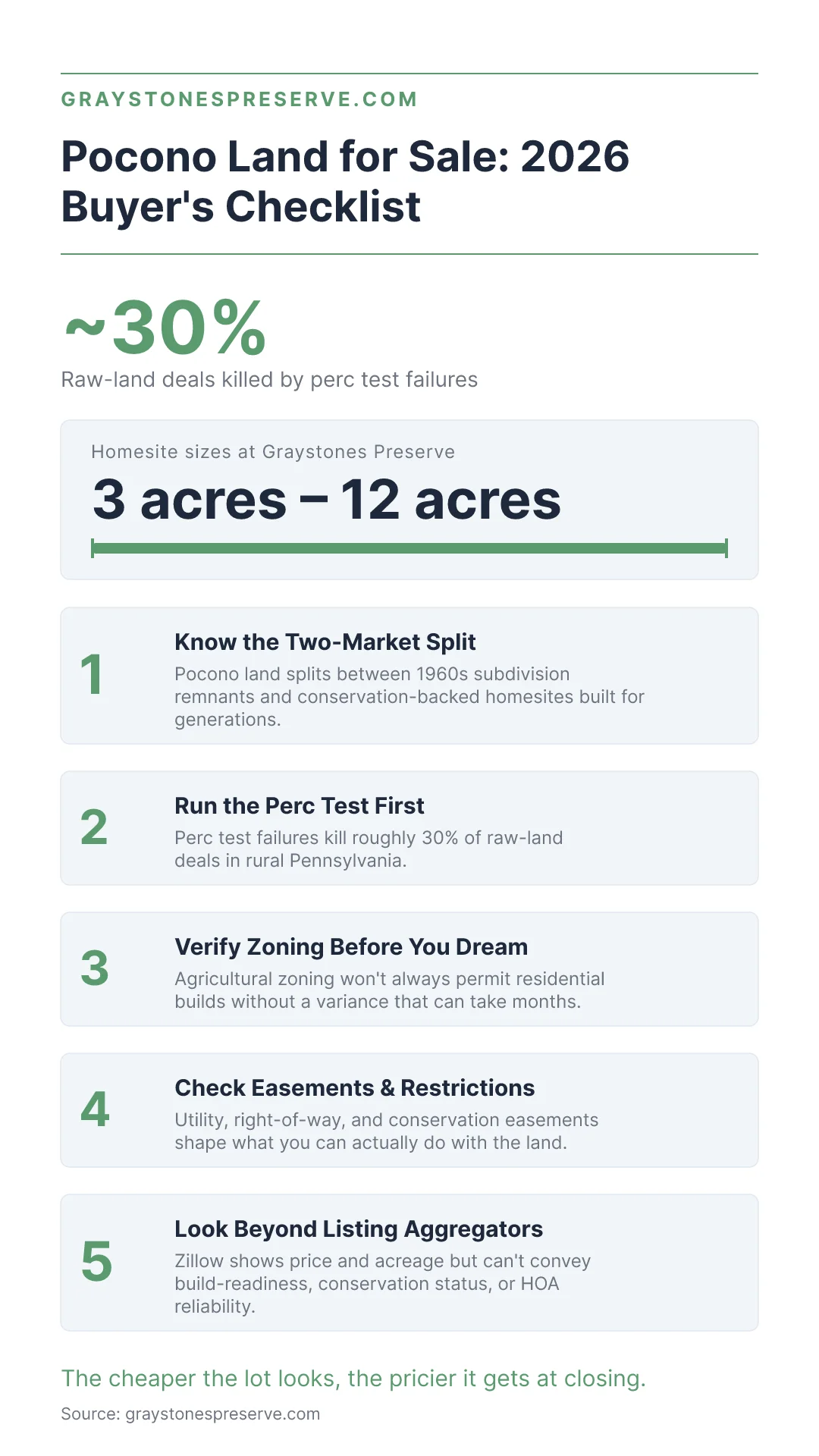
The Buyer's Checklist
1. Deed Restrictions and Covenant Review
Before price or acreage, pull the full deed and any recorded covenants from the Pike, Monroe, or Wayne County recorder's office. Pocono parcels from the 1960s–80s resort subdivision era routinely carry restrictions that prohibit year-round residency, limit construction to certain square footages, require membership in defunct or insolvent homeowner associations, or restrict subdivision by future owners.
Some restrictions have lapsed; others are enforceable in perpetuity. A Pennsylvania real estate attorney — not just a title company — should review these before you proceed.
2. Water Rights, Well Feasibility, and Septic Capacity
Surface water (streams, ponds, springs) on a parcel may look like an asset, but in Pennsylvania, riparian rights are complex and often severed from surface ownership. Before assuming you can draw water from a stream on "your" land, confirm water rights in writing.
For potable water and sewage, commission a well yield test and a perc test (soil percolation test) before closing. Both are prerequisites for a DEP-approved septic system, and both can fail on parcels that appear suitable from the road. Failed perc tests have stranded buyers with unbuildable land.
3. Road Access and Maintenance Obligations
Pocono parcels accessed by private roads require a legally recorded easement granting you the right to use that road. Confirm that your parcel has a recorded right-of-way and — critically — that the road maintenance agreement specifies who bears the cost of upkeep, snow removal, and repair.
In many old subdivisions, road maintenance obligations fall to individual lot owners in rotating shares, or to homeowner associations that may have dissolved. Buyers have inherited surprise assessments of $15,000–$40,000 to repair a single winter's worth of damage on a gravel mountain road.
4. Pennsylvania Clean and Green (Act 319) Status
Many large Pocono parcels are enrolled in Pennsylvania's Clean and Green program, which provides preferential tax assessment in exchange for keeping the land in agricultural, forest, or open-space use. The reduced property tax can look attractive at first glance — until you discover that withdrawing from the program to build triggers a rollback penalty of up to seven years of deferred taxes plus interest, often amounting to tens of thousands of dollars.
Contact the county assessor directly and confirm the parcel's enrollment status and any outstanding rollback liability before closing.
5. Timber Rights and Mineral Rights
Pennsylvania has a long history of severed estates — properties where the mineral rights (coal, gas, oil) or timber rights were separated from the surface deed generations ago. You may own the surface, but a third party may have the right to enter the land and extract resources.
A title search in Pennsylvania should include a mineral rights review. Gas lease activity in the Pocono region has been active in parts of Pike and Wayne counties. Confirm full fee simple ownership — or understand exactly what rights you're acquiring.
How Graystones Preserve Addresses Every Item
Graystones Preserve was designed by owners who had seen these problems first-hand in other Pocono transactions. Rather than asking buyers to navigate the checklist themselves, the preserve resolves each item structurally:
- Deed restrictions — Graystones covenants protect the character of the preserve in perpetuity while explicitly permitting full-time residency and custom construction on 3-acre and 12-acre homesites.
- Water and septic — Community water infrastructure and engineered septic planning are part of the site development. Buyers do not face individual well or perc uncertainty.
- Roads — Private roads within the preserve are owned and maintained by the community association, with funded reserves for ongoing upkeep. No surprise assessments.
- Clean and Green — The preserve's conservation easement structure provides lasting tax and environmental benefits without the rollback exposure of standard Act 319 enrollment.
- Mineral and timber rights — Graystones holds fee simple title inclusive of mineral rights. Conservation covenants further protect the land's surface from extractive activity.
The result is a parcel that passes every item on this checklist before you even ask — and a community infrastructure that most individual Pocono land listings simply cannot replicate.
Frequently Asked Questions
How much does Pocono land cost in 2026?
Raw, undeveloped Pocono land ranges from under $50,000 for small subdivision remnants to well over $1 million for large, private parcels with water access and deed protections. At Graystones Preserve, 3-acre homesites are priced around $600,000 and 12-acre homesites around $900,000 — reflecting infrastructure, conservation protections, and private community amenities that raw land cannot offer.
Is it difficult to get a building permit for Pocono land?
Permitting complexity varies significantly by township and parcel history. Deed restrictions, septic feasibility, DEP wetland buffers, and municipal zoning all affect what you can build and where. At Graystones, the site planning and covenant framework has already navigated these constraints, so buyers begin the design process with a clear building envelope.
Can I buy land in the Poconos and build immediately?
On raw, unimproved Pocono land, the timeline from closing to construction start typically runs 12–24 months after accounting for permits, utilities, well drilling, septic approval, and township review. At Graystones Preserve, community infrastructure is already in place, compressing that timeline substantially.
What is the biggest mistake Pocono land buyers make?
Skipping the deed and covenant review. Buyers often focus on acreage and topography and overlook recorded restrictions that materially limit what the land can be used for. A full title examination by a Pennsylvania real estate attorney — before making an offer — is the single most protective step any buyer can take.